
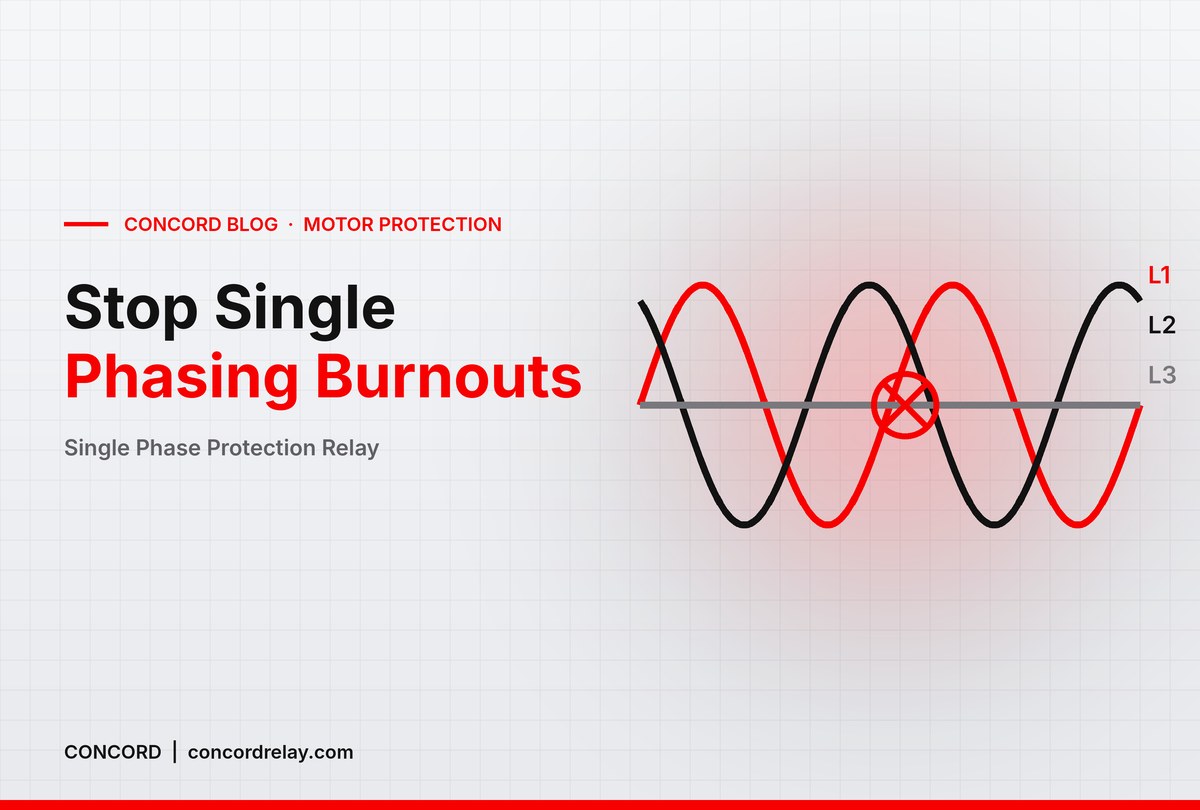
Single Phase Protection Relay: Motors and Single Phasing
Search for a “single phase protection relay” and you will find two very different products under the same name. Some buyers want to protect a single-phase motor, such as a small domestic pump or a workshop compressor. Others want protection against single phasing, the loss of one supply phase on a three-phase motor. Both are common in Indian installations, and both are handled by electronic motor protection relays, but the selection logic is not the same.
This guide explains both meanings, why single phasing is so damaging, and which CONCORD EOCR model suits each job, with phase-loss trip times for comparison.
Two Meanings of “Single Phase Protection Relay”
1. Protecting a single-phase motor
Single-phase motors run small pumps, fans, blowers and light machinery. They face overload, locked rotor (a jammed impeller or a failed start capacitor keeps the rotor from turning) and sustained overcurrent from low supply or mechanical drag. A relay for this duty needs a low current range, a starting delay to ride through inrush, and a reliable overcurrent trip.
2. Single phasing (phase loss) protection on a three-phase motor
Here the motor is three-phase, but one of the three phases disappears while it is running or before it starts. The relay must detect that one line current has dropped away and trip the contactor before the windings overheat. This is the more common intent, and the more expensive fault to miss.
Why Single Phasing Is So Damaging
When one phase is lost on a running three-phase motor, the motor usually keeps turning on the remaining two phases. To deliver the same shaft power, it draws noticeably higher current through the two healthy lines. Negative-sequence currents also heat the rotor. If nobody intervenes, the stator insulation degrades and the winding fails.
If the phase is already missing when the motor is switched on, the motor cannot develop starting torque. It sits stalled, drawing locked-rotor current, which can damage the winding within a short time.
Common causes in Indian plants and pump houses
- One fuse blown in a fuse-switch unit or a single pole of a protective device tripped
- Loose or burnt terminal at the starter, contactor or motor terminal box
- Worn or pitted contactor contacts that fail to make on one pole
- Broken conductor in a long submersible or borewell cable
Why a thermal overload relay can miss it
A bimetal thermal overload relay responds only to the heating effect of current. If the motor is lightly loaded when a phase is lost, the current in the healthy lines may stay below the set value, so the bimetal never trips, even though the motor is running unbalanced and heating internally. An electronic relay that watches each phase current separately recognises the missing phase itself and trips on that condition, whatever the load.
How an Electronic Single Phase Protection Relay Detects Phase Loss
CONCORD EOCR relays measure motor current through integral current transformers (two or three, depending on the model) or through external CTs for larger motors. The microcontroller or solid-state circuit compares the phase currents continuously. When one phase falls away while the others carry current, the relay treats it as phase loss and opens its output contact after a short, defined time.
Note that this is current-based detection. The EOCR range does not monitor supply voltage; it protects the motor by watching what the motor actually draws. Short-circuit protection remains the job of the MCCB or fuses upstream, and the relay is applied together with them.
Phase-Loss Trip Times by CONCORD Model
Every CONCORD EOCR model works as a single phase protection relay for three-phase motors, differing in trip speed, display and other faults covered. The full motor protection relay range is summarised below.
| Model | Type | Phase-loss trip | Fault indication | Current range (direct) |
|---|---|---|---|---|
| EOCR SS | Analog, solid state | Within set O-Time (D-Time + O-Time at start) | 2 LEDs | 0.5-6A, 3-30A, 5-60A |
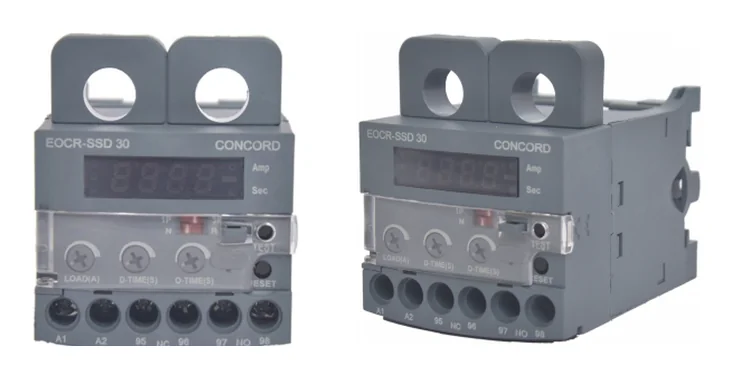
| EOCR SSD | Analog with digital display, 2 CT | Within 3 s | 7-segment display: PL-1 / PL-2 / PL-3 | 0.5-6A, 3-30A, 10-60A |
| EOCR DS | MCU based, 3 CT | Within 4 s | 2 LEDs with fault diagnosis | 0.5-6A, 3-30A, 10-60A |
| EOCR 3DE / 3EZ | MCU based digital, 3-phase | Trips and shows phase loss on display | Trip cause on 7-segment display | 0.5-60A definite time; up to 600A with external CTs |
Every model also works with external CTs of 5A secondary for motors above its direct range, up to 600A running current.
Choosing the Right Relay for Your Application
For single-phase motors
The EOCR SSD is the model specified as suitable for single-phase or three-phase motors. It gives overcurrent protection with independent D-Time (1-30 s) and O-Time (1-10 s) settings, and locked-rotor protection that operates immediately if 200% or more of set current continues after D-Time. For small motors in the 05 range, looping the line wire through the internal CT more than once improves accuracy at low currents. Confirm the wiring scheme for single-phase use with CONCORD before commissioning.
For single phasing on three-phase motors
- Basic panels, cost-sensitive OEM builds: EOCR SS covers overcurrent, phase loss and locked rotor, with a universal 24-240V AC/DC supply and NVR / fail-safe function.
- Where maintenance staff need to see the faulty phase: EOCR SSD shows exactly which line was lost, so the electrician goes straight to that fuse or terminal.
- Pumps, compressors and conveyors where rotation matters: EOCR DS adds phase reverse protection within 0.1 s alongside phase loss within 4 s.
- Critical motors needing unbalance, undercurrent or ground fault: EOCR 3DE / 3EZ adds phase unbalance, reverse phase, rotor jam and undercurrent, with ground fault on the 3EZ via a ZCT.
For a broader look at three-phase fault types, see our guide to the 3 phase motor protection relay. Pump users may also want to read about dry run protection relays.
Setting Tips for Your Single Phase Protection Relay
- Set current to the motor’s actual running current, not just the nameplate. A setting far above running current reduces sensitivity to every fault.
- Set D-Time to cover the real starting period. Too short causes nuisance trips on start; too long leaves the motor exposed if it starts on two phases.
- Keep O-Time short enough to trip before the winding overheats, especially on submersible motors with limited thermal margin.
- Use the TEST button during commissioning and periodic maintenance. The relay trips after D-Time + O-Time; press RESET afterwards.
- Find the root cause before resetting. After a phase-loss trip, check fuses, terminals and contactor poles before restarting.
Frequently Asked Questions
What is single phasing in a three-phase motor?
Single phasing is the loss of one of the three supply phases. The motor either keeps running on two phases with higher current and extra heating, or fails to start and draws locked-rotor current. Either way, the winding is at risk unless a relay trips the motor.
Can an overload relay protect against single phasing?
A thermal overload relay may trip if the extra current is high enough, but it can miss phase loss on a lightly loaded motor. An electronic relay with dedicated phase-loss protection, such as the CONCORD EOCR range, detects the missing phase directly.
Which CONCORD relay can be used for a single-phase motor?
The EOCR SSD is suitable for both single-phase and three-phase motors. It provides overcurrent and locked-rotor protection with a digital display of motor current and trip cause.
How fast does a single phase protection relay trip on phase loss?
The EOCR SSD trips within 3 s and the EOCR DS within 4 s. The EOCR SS operates within its set O-Time. The 3DE / 3EZ trips on phase loss and shows it as the trip cause on the display.
Does a phase-loss relay replace the MCCB or fuse?
No. The EOCR protects the motor against overcurrent, phase loss and related running faults. Short circuits must still be cleared by an upstream MCCB or fuse.
Not sure which model fits your motor or pump set? Talk to CONCORD for selection help. Call or WhatsApp +91 96670 40511, email contact@concordrelay.com, or use our contact page. You can also download the CONCORD EOCR brochure for full specifications.
1 comment on “Single Phase Protection Relay: Motors and Single Phasing”