
Instant Motor Protection Relay: What Fast Tripping Really Means
Engineers searching for an instant motor protection relay usually want one thing: a device that disconnects the motor the moment something goes wrong. In practice, no motor relay can trip instantly on every abnormal current. A direct-on-line motor draws several times its full-load current for a few seconds at every start, so a relay that tripped with zero delay would never let the motor run.
What a good electronic relay offers instead is fast, deliberate tripping on the faults where seconds matter, and a controlled delay where they do not. Short-circuit currents, which need clearing in milliseconds, are handled by a different device altogether.
This article explains what “instant” means in motor protection, which faults justify the fastest trips, and how to set a relay for quick response without nuisance trips.
What “Instant” Means in Motor Protection
In protection terms, “instantaneous” means operation with no intentional time delay. MCCB magnetic releases and fuses work this way: they clear a short circuit within milliseconds to limit the energy released into cables and switchgear.
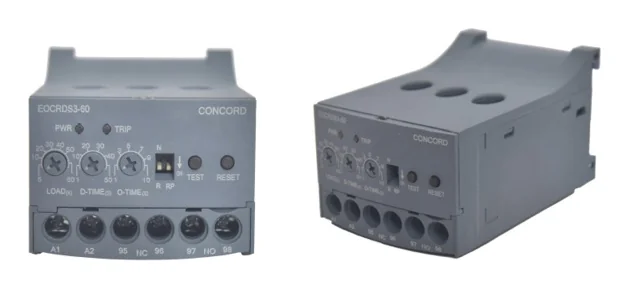
A motor protection relay works on a different principle. It measures current through integral current transformers, compares it with the set value, and acts through the contactor. Its trip times run from a fraction of a second to several seconds, by design, because:
- Starting inrush is normal and must be ignored for the duration of the start (the D-Time).
- Brief load fluctuations are not faults and should not stop production.
- A contactor is not designed to break short-circuit current, so the relay should not be the device that tries to.
So an instant motor protection relay, in practical terms, is a relay with very short and accurate operating times on the faults that need them.
The Fastest Trips on CONCORD EOCR Relays
Each model in the CONCORD motor protection relays range has defined trip times for each fault, taken from the 2025-26 brochure:
| Fault | Model | Trip time |
|---|---|---|
| Reverse phase | EOCR DS | Within 0.1 s |
| Locked rotor | EOCR SSD | Immediately, if 200% or more of set current continues after D-Time |
| Locked rotor | EOCR DS | Within D-Time |
| Over current (shortest setting) | EOCR SS / DS | O-Time adjustable down to 0.2 s |
| Over current (shortest setting) | EOCR 3DE/3EZ | Definite-time operation adjustable from 0.2 s |
| Phase loss | EOCR SSD / DS | Within 3 s / within 4 s |
Reverse phase in 0.1 s
If two supply phases are swapped, a 3-phase motor runs backwards. The EOCR DS MCU based relay detects phase reversal and trips within 0.1 s, before the motor has built up meaningful reverse speed. The EOCR 3DE/3EZ also detects reverse phase and shows it on the display.
Locked rotor right after D-Time
A stalled motor draws close to starting current continuously, and its windings heat up very quickly because there is no cooling airflow from rotation. On the EOCR SSD, if current stays at 200% or more of the set value after D-Time ends, the relay trips immediately rather than waiting for O-Time.
Short O-Time for overcurrent
Where a running overload signals mechanical trouble, such as a jammed conveyor or crusher, O-Time on the SS and DS can be set as low as 0.2 s.
Instant Motor Protection Relay vs Short-Circuit Devices
| Device | Faults covered | Speed |
|---|---|---|
| MCCB / fuse | Short circuit (and overload, in thermal-magnetic MCCBs) | Milliseconds for short circuit |
| Electronic motor protection relay (EOCR) | Over current, phase loss, locked rotor, phase reversal, unbalance, jam, ground fault (3EZ with ZCT), undercurrent (3DE/3EZ) | 0.1 s to seconds, as set |
| Contactor | Switching device, operated by the relay contact | Opens when the relay trips |
The EOCR does not replace the MCCB or fuse. A complete motor feeder needs both: a short-circuit protective device upstream, and an electronic relay for running faults that a breaker cannot see accurately.
Where an Instant Motor Protection Relay Pays Off
- Compressors: many compressor designs can be damaged by running in reverse, so a sub-second reverse phase trip is valuable after any supply rework.
- Conveyors and hoists: wrong direction of travel creates a safety and material-handling risk.
- Crushers, mixers and conveyors: a jam or stall needs a quick stop to protect gearboxes, couplings and belts as well as the motor.
- Pumps: reverse rotation reduces or stops flow, and a pump running against a blockage can overheat quickly.
- Small motors: they have less thermal mass, so they heat up faster under locked rotor conditions.
When Not to Set Everything to Minimum
Fast does not mean everything at the lowest setting. The most common causes of nuisance trips are:
- D-Time shorter than the actual starting time, especially on star-delta starters and high-inertia fans.
- O-Time of 0.2 s on loads with normal short peaks, such as compressors loading and unloading.
- Current set exactly at running current with no margin for normal variation.
Measure the real starting time, set D-Time a few seconds longer, and keep the shortest O-Time for drives where a running overload almost always means a mechanical fault. Our guide to the definite time motor protection relay walks through setting examples, and the article on reverse phase protection relays covers phase sequence faults in more depth.
After setting, press TEST: the relay trips after D-Time + O-Time, confirming the timers. Then press RESET.
Frequently Asked Questions
Is there a motor relay that trips instantly on overload?
Not without an intentional delay, because every motor start involves high inrush current. Electronic relays use D-Time to ignore the start and a short O-Time, down to 0.2 s on some models, for fast running-overload trips.
Can an EOCR replace an MCCB or fuse?
No. Short-circuit protection is the job of the MCCB or fuse upstream. The EOCR protects against running faults such as overload, phase loss, locked rotor and phase reversal.
How fast does a relay trip on phase reversal?
The CONCORD EOCR DS trips on phase reverse within 0.1 s. The EOCR 3DE/3EZ also detects reverse phase and displays it as the trip cause.
Which relay gives the fastest locked rotor protection?
The EOCR SSD trips immediately if 200% or more of set current continues after D-Time, and the EOCR DS trips on locked rotor within D-Time.
Will a very short O-Time cause nuisance trips?
It can on loads with normal current peaks. Use the shortest O-Time only where a running overload reliably indicates a jam or fault.
Not sure which trip times suit your motors? Talk to CONCORD for selection and setting help: call or WhatsApp +91 96670 40511, email contact@concordrelay.com, or reach us through the contact page. Download the CONCORD EOCR brochure for full specifications.