
Buy Electronic Overload Relay: A Practical Buyer’s Guide
If you plan to buy electronic overload relay units for a new panel, or to replace ageing bimetal relays, the catalogue number should be the last decision, not the first. The motor’s full load current, the type of load, the faults you need to catch and the control supply in your panel decide whether a relay protects the motor or trips at the wrong moment.
This guide is for plant engineers, panel builders, OEMs and purchase teams. It covers electronic vs thermal relays, sizing, model selection and what to share when you ask for a quotation.
Electronic vs thermal overload relays: why the switch is worth it
A conventional thermal overload relay uses bimetal strips heated by motor current. The bimetal also reacts to air temperature inside the panel, so in a closed panel during an Indian summer it can trip early, and in a cool room it can trip late. Calibration also drifts with age.
An electronic overload relay measures current through current transformers (CTs) and compares it with the set value using solid-state or microcontroller (MCU) circuits. Because it does not rely on heat, it is ambient insensitive. It also allows separate starting and trip time settings, and adds phase loss and locked rotor protection.
| Factor | Thermal (bimetal) relay | Electronic relay (EOCR) |
|---|---|---|
| Sensing method | Heating of a bimetal strip | Current measured through CTs |
| Effect of panel temperature | Significant | Ambient insensitive |
| Starting delay | Fixed by trip class | Adjustable D-Time |
| Trip time on overload | Fixed curve | Adjustable O-Time or inverse class |
| Phase loss and locked rotor | Limited or none | Built in |
| Fault indication | Usually none | LEDs or digital trip cause display |
| Current reading | Not available | Ammeter function on digital models |
What to check before you buy electronic overload relay units
1. Motor full load current and relay range
Take the full load current (FLC) from the motor nameplate rather than working from the kW rating alone, since FLC varies with efficiency, voltage and number of poles. CONCORD relays come in 05 type (0.5-6A), 30 type (3-30A) and 60 type (5-60A on the SS, 10-60A on the SSD and DS). Pick the range where the FLC sits comfortably inside the band, not at its extreme ends.
2. Small motors and looping
For very small currents, the line wire can be passed through the relay’s internal CT more than once. On an 05 type relay, two turns give a 0.25-3A range and five turns give 0.1-1.2A. This improves accuracy on fractional-kW motors.
3. Large motors and external CTs
For motors beyond the direct range, an 05 type relay is used with external CTs of 5A secondary to protect motors with running currents up to 600A. CONCORD supplies single hole SCR-CTs and 2-hole and 3-hole combined CTs from 100:5 to 400:5 for this purpose.
4. The faults you need to catch
- Overcurrent: needed on every motor.
- Phase loss (single phasing): essential on all 3-phase motors.
- Locked rotor and jam: important for crushers, mixers and conveyors.
- Reverse phase: where wrong rotation can damage pumps, compressors or conveyors.
- Phase unbalance: on weak or rural supplies with uneven loading.
- Undercurrent: for pumps that may run dry or lose load.
- Ground fault: for submersible motors and wet or dusty sites.
5. Control supply and output contacts
Check the control voltage in your panel. The SS and SSD accept a universal 24-240V AC/DC supply, the DS works on 180-260VAC, and the 3DE/3EZ accept 100-240VAC/DC with a 24VAC/DC option. Also confirm the contacts suit your starter circuit: the SS and SSD have 2 SPST contacts rated 3A/250VAC, while the DS has one SPDT contact.
6. Display, diagnostics and mounting
LED indication is enough for many machines. Where maintenance teams want live current readings and trip causes, a digital display saves troubleshooting time. All CONCORD models mount on a 35mm DIN rail or base.
Which CONCORD EOCR model should you buy?
Once the checks above are done, the decision to buy electronic overload relay models narrows to five options.
| Model | Type | Key protections | Best suited for |
|---|---|---|---|
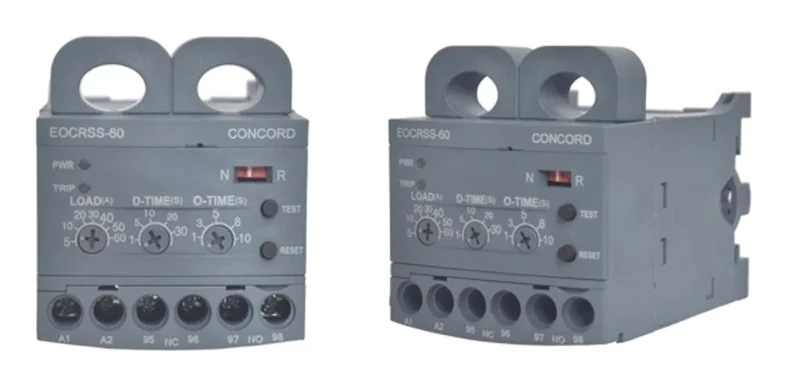
| EOCR SS | Analog solid state, 2 LEDs | Overcurrent, phase loss, locked rotor; NVR / fail-safe function | General-purpose motors, OEM panels, thermal relay replacement |
| EOCR SSD | Analog with digital display, 2 CT | Overcurrent, phase loss, locked rotor; trip cause display | Direct SS replacement with current reading; 1-phase or 3-phase motors |
| EOCR DS | MCU based, 3 integral CTs | Overcurrent, phase loss, locked rotor, reverse phase | Pumps, compressors and conveyors where rotation matters |
| EOCR 3DE | MCU based digital | Overcurrent, phase loss, unbalance, reverse phase, rotor jam, locked rotor, undercurrent | Critical 3-phase motors and pumps needing dry-run detection |
| EOCR 3EZ | MCU based digital with ZCT input | All 3DE functions plus ground fault | Submersible pumps and sites where insulation failure is a risk |
Full specifications are on the EOCR SS and EOCR 3DE/3EZ digital relay pages. If you are still comparing options, our article on how to judge the best motor protection relay sets out the criteria in more depth.
Setting D-Time and O-Time after installation
Two settings matter most on analog and MCU models. D-Time (starting delay) is the time allowed for the motor to reach normal running current during its high inrush start, so the relay does not trip while the motor accelerates. O-Time is how long the relay waits after current exceeds the set value before tripping.
Example: a pump motor with an FLC of 18A that takes about 4 seconds to reach speed suits a 30 type relay. Set the current close to FLC as per the motor maker’s guidance, set D-Time a little longer than the starting time (say 6 seconds) and keep O-Time short enough to prevent overheating. Then press the TEST button: the relay should trip after D-Time plus O-Time. Press RESET before restarting.
Common mistakes when buying overload relays
- Selecting by motor kW without checking nameplate current, or picking a range where FLC sits at the edge of the scale.
- Expecting the overload relay to clear short circuits. That is the job of the upstream MCCB or fuse; the EOCR handles overload and running faults.
- Ignoring the panel control voltage when choosing the model.
- Forgetting external CTs for large motors, or the ZCT/CBCT when ordering an EOCR 3EZ for ground fault protection.
How to place an order
When you are ready to buy electronic overload relay units, share these details: motor kW and nameplate FLC, supply voltage, single-phase or three-phase, application (pump, compressor, conveyor and so on), starter type, panel control voltage, quantity, and whether external CTs are needed. For background on how relay designs differ, see our guide to the types of electronic motor protection relay.
Frequently Asked Questions
Is an electronic overload relay better than a thermal overload relay?
For most motor applications, yes. It is ambient insensitive, has separate starting and trip time settings, and adds phase loss and locked rotor protection. Thermal relays remain acceptable for simple, non-critical loads.
How do you select the current range of an overload relay?
Read the full load current from the motor nameplate and choose the range where that value sits well inside the band. For very small motors use looping; for motors beyond 60A use an 05 type relay with external CTs of 5A secondary.
Can an electronic overload relay protect against short circuits?
No. Short-circuit protection must come from an MCCB or fuse upstream. The overload relay protects against overcurrent, phase loss, locked rotor and other running faults, depending on the model.
Which overload relay suits a submersible pump?
The EOCR 3DE offers undercurrent protection for dry-run detection. The EOCR 3EZ adds ground fault protection with a ZCT, which is useful for submersible motors where insulation can fail.
Can one relay model cover different motor sizes?
The EOCR 3DE/3EZ can be used for motor currents from 0.5A to 600A with external CTs, which helps reduce the number of models held in inventory.
Need help choosing? Talk to the CONCORD team with your motor details and application. Call or WhatsApp +91 96670 40511, email contact@concordrelay.com, or use our contact page. You can also download the EOCR brochure to compare models before you buy.