
Digital Overload Relay Features: A Practical Guide
A thermal overload relay tells you one thing: it has tripped. A digital overload relay tells you what the motor is drawing, why it stopped, how heavily it is loaded and whether the relay itself is healthy. For maintenance teams that run dozens of pumps, compressors and conveyors, those digital overload relay features are the difference between a ten-minute fault-finding job and half a shift lost.
This article walks through each feature you will find on a modern digital motor protection relay, explains what it does in practice, and shows where each one appears in the CONCORD EOCR range. Use these digital overload relay features as a checklist when comparing relays or writing a panel specification.
What Makes an Overload Relay “Digital”?
In a digital relay, motor current is measured through current transformers and processed by a microcontroller (MCU) rather than by a bimetal strip. The measured values are shown on a 7-segment LED display, and settings are entered as numbers rather than by turning a dial against a printed scale. Because sensing is electronic, the relay is insensitive to ambient temperature, which matters in hot Indian panel rooms where bimetal relays tend to drift.
Within the CONCORD range, the EOCR SSD pairs analog protection with a digital display, while the EOCR 3DE and 3EZ are fully MCU-based digital motor protection relays with the widest feature set.
Key Digital Overload Relay Features Explained
1. Built-in ammeter display
The display works as an ammeter, showing actual motor current. On the EOCR 3DE / 3EZ, the three phase currents are shown one after another, L1 → L2 → L3. The EOCR SSD shows the maximum current in any phase. Technicians can read running current without a clamp meter, spot a phase drawing more than the others, and set the relay against real current rather than the nameplate. When external CTs are used, the displayed current values are selectable, so the reading matches actual motor current.
2. Trip cause (fault diagnosis) display
After a trip, the display shows why the relay operated. On the EOCR SSD the codes are:
- oc — over current
- PL-1 / PL-2 / PL-3 — phase loss in L1, L2 or L3
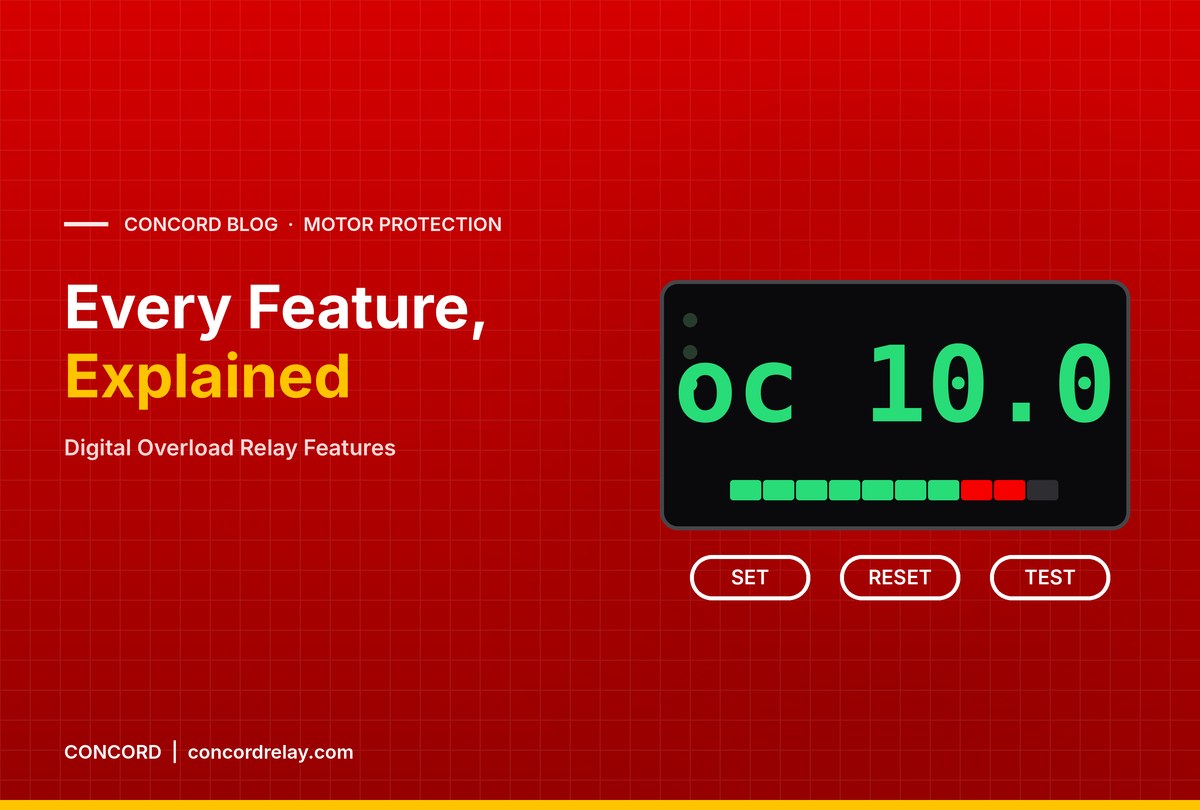
- -LC- — locked rotor
The EOCR 3DE / 3EZ displays overcurrent, phase loss, phase unbalance, reverse phase, rotor jam, locked rotor / stall and, on the 3EZ, ground fault. Knowing the cause tells the electrician whether to check a fuse, a terminal, the driven load or the cable insulation.
3. Load factor bar graph
The 3DE / 3EZ has a bar graph showing load factor from 65% to 100% of the set current. At a glance an operator can see whether a motor is running lightly or close to its trip point. A pump that slowly creeps up the bar graph over weeks may be pointing to a choked strainer or worn bearings.
4. Test function
A front-panel TEST button checks relay health without energising the motor circuit. The relay trips after D-Time + O-Time, proving the output contact and timing work, and RESET returns it to normal. This makes routine relay checks a two-minute task during preventive maintenance.
5. Independent D-Time and O-Time settings
D-Time (starting delay) lets the motor pass its high inrush current during start without nuisance trips. O-Time (operating time) sets how quickly the relay trips once running current exceeds the set value. On the 3DE / 3EZ the manoeuvre (start) delay is adjustable from 0 to 200 s, useful for high-inertia loads such as fans and crushers, and definite-time operation is adjustable from 0.2 to 30 s.
6. Definite and thermal inverse characteristics
The 3DE / 3EZ can be set for definite-time or thermal inverse tripping. Definite time trips after a fixed delay regardless of how large the overload is. Thermal inverse trips faster on heavy overloads and slower on light ones, closer to how a motor actually heats. Inverse class is selectable from 1 to 30, so the curve can be matched to the motor’s thermal capacity.
7. Undercurrent (low current) protection
A digital relay can also trip when current falls too low. On the 3DE / 3EZ the low current setting ranges from 0.5A up to the overcurrent setting, or OFF, with an operation time of 0.5 to 30 s. Because a pump running dry or a conveyor with a broken belt draws less current, this function provides dry-run and loss-of-load detection without separate level sensors. Read more in our guide to dry run protection relays.
8. Automatic reset
The 3DE / 3EZ offers automatic reset with an adjustable time from 0.5 s to 20 minutes, alongside manual and electrical remote reset. Auto reset suits unattended pump stations where a motor should restart after, for example, water level recovers. It should be used with care on machines where an unexpected restart is unsafe.
9. Wide range and external CT support
The same 3DE / 3EZ model covers motors from 0.5A to 600A when used with external CTs, so a plant can stock fewer relay variants. Definite-time overcurrent covers 0.5-60A directly; inverse-time covers 0.5-32A directly, with external CTs above that.
10. Multiple outputs and free-voltage supply
Output contacts are rated 3A/250VAC resistive, configured for overcurrent (1a1b), warning and undercurrent. The supply accepts 100-240VAC/DC free voltage or 24VAC/DC at 50/60 Hz, with a 7VA burden.

Feature Comparison: CONCORD Digital and Analog Relays
| Feature | EOCR SS | EOCR SSD | EOCR DS | EOCR 3DE / 3EZ |
|---|---|---|---|---|
| Current display | 2 LEDs (status, current check) | Max phase current | 2 LEDs (run monitor) | L1, L2, L3 sequential |
| Trip cause indication | LEDs | Codes (oc, PL, -LC-) | LEDs with fault diagnosis | Full code display |
| Load factor bar graph | No | No | No | Yes, 65-100% |
| Test function | Yes | Yes | Yes | Yes |
| Trip characteristic | Definite | Definite | Definite (inverse on request) | Definite / thermal inverse, class 1-30 |
| Undercurrent | No | No | No | Yes |
| Reset | Manual / remote | Manual / remote | Manual / remote | Manual / remote / auto (0.5 s-20 min) |
| Ground fault | No | No | No | 3EZ with ZCT |
See the complete motor protection relay range for detailed specifications.
Which Digital Overload Relay Features Matter for Your Application?
- Borewell and booster pumps: undercurrent for dry run, ammeter display, auto reset for unattended sites.
- Compressors and HVAC blowers: long start delay, thermal inverse characteristic, reverse phase protection.
- Crushers, mixers and conveyors: rotor jam and locked rotor detection with clear trip cause display.
- OEM machine panels: wide current range per model to reduce variants, compact DIN-rail mounting.
- Critical process motors: ground fault on the 3EZ with a CBCT / ZCT, plus the bar graph for trend watching.
For a deeper look at how these relays work internally, read our explainer on the digital motor protection relay.
Frequently Asked Questions
What is the main advantage of a digital overload relay over a thermal relay?
A digital overload relay measures current electronically, so it is accurate and unaffected by ambient temperature. It also displays motor current and the cause of a trip, which shortens troubleshooting.
Can a digital overload relay detect dry running of a pump?
Yes, if it has an undercurrent function. The EOCR 3DE / 3EZ trips when current falls below the low current setting for the set time, which is what happens when a pump loses water.
What does the load factor bar graph show?
It shows motor current as a percentage of the set current, from 65% to 100%, so operators can see how close the motor is running to its trip point.
Does a digital overload relay protect against short circuits?
No. It protects against overload and running faults. Short-circuit protection must come from an upstream MCCB or fuse.
Can one digital relay cover large motors?
Yes. With external CTs of 5A secondary, the EOCR 3DE / 3EZ protects motors up to 600A running current.
Need help matching relay features to your motors? Talk to CONCORD for selection support. Call or WhatsApp +91 96670 40511, email contact@concordrelay.com, or reach us through the contact page. Full specifications are in the CONCORD EOCR brochure.