
Earth Leakage Protection Relay for Motors: ZCT & EOCR 3EZ
Insulation in a motor winding does not fail all at once. Moisture in a submersible pump cable, contamination in a damp pump room or ageing varnish in a hot compressor motor slowly lets current leak to the frame and to earth. An earth leakage protection relay watches for that leakage and stops the motor before a small fault grows into a burnt winding, a damaged cable or a fire.
In motor circuits the term covers two different jobs that are often confused: protecting the motor and installation against ground faults, and protecting people against electric shock. This guide explains the difference, how a zero-sequence CT (ZCT or CBCT) detects leakage, and how the EOCR 3EZ with a ZCT fits into a motor starter panel.
What Is Earth Leakage in a Motor Circuit?
In a healthy three-phase motor circuit, all the current that flows out on the line conductors returns on the same conductors. The instantaneous sum of the three line currents is zero. When insulation breaks down, part of the current finds a path through the motor body, the earth conductor or the pipework to earth. That residual current is earth leakage, or a ground fault when it is larger.
Common causes in Indian installations include:
- Water ingress in submersible and borewell pump cables and joints
- Condensation in motors that stand idle through the monsoon
- Insulation ageing from repeated overheating or frequent starts
- Cable damage from rodents, abrasion or poor glanding
- Dust and conductive contamination in cement, textile and process plants
Left undetected, leakage current heats the insulation further, eventually turning into a phase-to-earth fault that can trip the upstream breaker, damage the motor beyond rewinding and create a shock hazard on exposed metal.
How an Earth Leakage Protection Relay Detects Ground Faults
The ZCT / CBCT principle
Most motor earth leakage protection relays rely on the same sensing method. A zero-sequence current transformer, also called a core balance CT (CBCT), is a ring-type CT through which all three phase conductors pass together. Under normal conditions their magnetic fields cancel and the CT secondary produces almost nothing. When some current leaks to earth, the currents no longer balance and the CT produces a signal proportional to the leakage. The relay measures this signal and trips when it exceeds the set level for the set time.
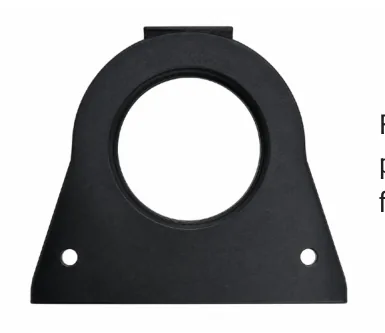
Installation points for the ZCT
- Pass all three phase conductors through the ZCT. Do not pass the earth conductor through it.
- Keep the conductors centred in the window where possible to avoid false readings during motor starting.
- Do not route cable armour or screen earth back through the ZCT, as this cancels the signal.
- Keep the ZCT secondary wiring short and away from power cables.
EOCR 3EZ with ZCT: Motor Ground Fault Protection
CONCORD’s EOCR 3DE/3EZ is an MCU based digital motor protection relay for three-phase motors. The 3EZ version adds ground fault protection when used with a CBCT/ZCT for EOCR 3EZ, which measures leakage current. The same relay also protects against:
- Overcurrent, with definite-time or thermal inverse characteristic
- Phase loss and phase unbalance
- Reverse phase
- Rotor jam and locked rotor / stalled motor
- Undercurrent, useful for pump dry-run detection
Its 7-segment display shows the three phase currents in sequence and, after a trip, shows the cause. A ground fault trip therefore points the electrician straight to an insulation problem instead of a mechanical one. With external CTs the same model covers motors from 0.5A to 600A, and supply options of 100-240VAC/DC or 24VAC/DC suit most control panels.
Note that the CBCT/ZCT is used with the 3EZ only. The 3DE and the other EOCR models do not include ground fault protection.
Motor Ground Fault Protection vs RCCB for Personnel Safety
This distinction matters for both safety and compliance. A residual current circuit breaker (RCCB) or RCBO rated at 30mA is designed to protect people against electric shock. It disconnects the supply very quickly at a leakage level low enough to prevent fatal shock. A motor ground fault relay is intended to protect the motor, cable and installation, and to stop the motor on insulation failure with a clear indication of cause.
| Aspect | Motor ground fault relay (e.g. EOCR 3EZ + ZCT) | RCCB / RCBO (30mA) |
|---|---|---|
| Primary purpose | Protect motor, cable and plant from insulation faults | Protect people from electric shock |
| How it disconnects | Opens the contactor coil through the relay contact | Breaks the circuit directly |
| Other functions | Overload, phase loss, unbalance, reverse phase, jam, undercurrent | Earth leakage only (RCBO adds overcurrent) |
| Fault indication | Trip cause on display | Usually none beyond the tripped lever |
| Typical use | Industrial motor starters, pump panels, OEM machines | Socket circuits, final distribution, personnel-accessible equipment |
Where people can touch equipment, such as farm pump sets, building water pumps and portable machinery, follow the applicable wiring rules and your consultant’s design for personnel protection. Use the motor ground fault relay in addition to, not instead of, the required shock protection. Neither device replaces short-circuit protection by the MCCB or fuses upstream.
Where Earth Leakage Protection Pays Off
An earth leakage protection relay adds the most value where moisture, contamination or high replacement cost make insulation failure likely or expensive:
- Submersible and borewell pumps: cable joints under water are the most common source of leakage.
- Sewage and effluent pumps: damp, corrosive environments degrade insulation quickly.
- Cooling tower fans and HVAC blowers: exposed to moisture and condensation.
- Process plant motors: in washdown or dusty areas.
- Critical motors: where a rewind or downtime costs far more than the relay.
For pumps, combining ground fault with undercurrent protection on one 3EZ covers two of the most frequent failure causes. Our article on dry run protection relays covers the undercurrent side in detail.
Frequently Asked Questions
What is the difference between an earth leakage relay and an RCCB?
An RCCB is designed for personnel safety and breaks the circuit itself at a low leakage level such as 30mA. A motor earth leakage or ground fault relay protects the motor and installation and trips the contactor through its output contact.
Which CONCORD relay has earth leakage protection?
The EOCR 3EZ, used with a CBCT/ZCT, provides ground fault protection by measuring leakage current. The 3DE, SS, SSD and DS do not include this function.
Why does a submersible pump trip on earth fault?
Usually because of water ingress in the cable joint, damaged cable insulation or a deteriorating motor winding. An insulation resistance test helps locate the fault.
Should the earth wire pass through the ZCT?
No. Only the phase conductors (and neutral, where used) should pass through. Passing the earth conductor through cancels the leakage signal.
Does earth leakage protection replace an MCCB?
No. The MCCB or fuses provide short-circuit protection. The earth leakage relay detects insulation faults and the EOCR handles running faults like overload.
For help selecting an EOCR 3EZ and the right ZCT for your motors, contact CONCORD on +91 96670 40511 (call/WhatsApp) or contact@concordrelay.com. You can also send us your motor details or download the CONCORD EOCR brochure.