
Reverse Phase Protection Relay: Stop Wrong Motor Rotation
Swap any two of the three supply phases and a three-phase induction motor runs in the opposite direction. On a fan this may only mean poor airflow. On a screw compressor, a hoist, a conveyor feeding a crusher or a pump with a threaded impeller, it can mean serious damage within seconds. A reverse phase protection relay detects the wrong phase sequence and stops the motor before reverse rotation does harm.
This guide explains why phase reversal happens, which machines are most at risk, how detection works and how CONCORD’s EOCR DS and EOCR 3DE/3EZ handle it.
Why Phase Reversal Happens
The standard phase sequence is R-Y-B (L1-L2-L3). Reversal occurs whenever any two phases are interchanged between the source and the motor. Typical situations in Indian plants and sites include:
- Supply work by the utility or after a transformer replacement
- Rewiring after a motor rewind or replacement
- Generator changeover where the DG set is connected with a different sequence from the mains
- Temporary connections on construction sites and rental equipment
- New panel installation or relocation of machines
The common thread is that someone has touched the wiring. Reversal is rarely a gradual fault; it appears suddenly at the next start.
Machines Where Reverse Rotation Is Dangerous
| Equipment | Risk from reverse rotation |
|---|---|
| Screw and scroll compressors | Loss of lubrication, overheating and damage to rotors or scrolls |
| Pumps with threaded impellers or shafts | Impeller can unscrew; poor or zero delivery; seal stress |
| Hoists, cranes and lifts | Load moves the wrong way; limit switches may not act as designed |
| Conveyors and elevators | Material spillage, belt damage, pile-ups at transfer points |
| Crushers, mixers and process machines | Mechanical damage, safety hazard to operators |
| Fans and blowers | Reduced airflow, process or ventilation failure |
For these machines, even a short period of reverse running matters, which is why trip speed is the key specification when choosing a reverse phase protection relay.
Why the risk is higher than it looks
Phase reversal tends to be found the hard way. A maintenance team restores supply late at night, a contractor reconnects a pump after rewinding, or a DG set takes over during a power cut. Nobody watches the shaft at the moment of restart, and an automatic or remote start can run a compressor backwards for minutes before anyone notices. Automatic protection removes this dependence on someone being present at the right moment.
How a Reverse Phase Protection Relay Works
A current sensing motor protection relay measures the three line currents through its integral CTs. Its microcontroller compares the order in which the current waveforms reach their peaks. If L2 leads L1 instead of lagging it, the sequence is reversed and the relay switches its output contact, dropping out the contactor.
Because detection is based on the motor currents, the relay sees the sequence once the motor is energised and current flows. Fast tripping keeps the reverse run to a fraction of a second, before the motor gathers meaningful speed in the wrong direction.
Reverse Phase Protection with EOCR DS and EOCR 3DE/3EZ
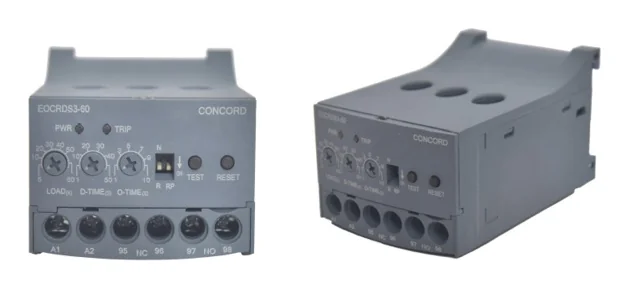
EOCR DS: phase reverse trip within 0.1 s
The EOCR DS is an MCU based solid state protection relay with three integral CTs. It trips on phase reversal within 0.1 s, on phase loss within 4 s, on locked rotor within D-Time and on overcurrent within O-Time. Ranges are 0.5-6A, 3-30A and 10-60A, with external CTs for 100A and above. Control voltage is 180-260VAC, and the single SPDT output contact is normally energised. Run monitoring and fault diagnosis are shown through two LEDs.
EOCR 3DE/3EZ: reverse phase plus full diagnostics
The EOCR 3DE/3EZ is an MCU based digital motor protection relay that includes reverse phase protection along with overcurrent, phase loss, phase unbalance, rotor jam, locked rotor and undercurrent, plus ground fault on the 3EZ with a ZCT. After a reverse phase trip, the digital display shows the cause, so the electrician knows to swap two phases rather than inspect the motor.
| Model | Reverse phase protection | Indication | Best fit |
|---|---|---|---|
| EOCR SS | Not available | 2 LEDs | Simple starters where rotation is fixed |
| EOCR SSD | Not available | 7-segment trip cause | 1-phase or 3-phase motors needing a digital display |
| EOCR DS | Yes, within 0.1 s | 2 LEDs with fault diagnosis | Compact starters for compressors, pumps, conveyors |
| EOCR 3DE/3EZ | Yes | Digital trip cause and phase currents | Critical motors needing full protection and diagnostics |
On panels where a reverse phase protection relay is the main requirement and space is tight, the DS is usually the practical choice; where operators also need live current readings and trip history, the 3DE/3EZ is the better fit. For a broader look at fast-acting functions, read our article on instant motor protection relays.
Application and Wiring Tips
- Confirm direction at commissioning. Check the incoming supply sequence at the panel and verify the machine rotates the right way before handing it over.
- Do not “fix” a trip by bypassing. If the relay trips on reverse phase after supply work, swap two incoming phases at the panel. Do not bridge the relay contact.
- Check DG changeover. Make sure the generator and mains have the same phase sequence at the changeover switch, or every motor will trip after transfer.
- Coordinate protection. The relay does not provide short-circuit protection; keep the MCCB or fuses correctly rated upstream.
- Use the TEST function. Periodically press TEST to confirm the relay and contactor respond, then RESET.
Frequently Asked Questions
What is a reverse phase protection relay?
It is a relay that detects when the supply phase sequence to a three-phase motor has been reversed and stops the motor to prevent it running in the wrong direction.
How fast does the EOCR DS trip on phase reversal?
The EOCR DS trips on phase reversal within 0.1 s, according to the CONCORD brochure.
What causes phase reversal in a 3-phase supply?
Any interchange of two phases, typically after supply maintenance, motor replacement, panel rewiring or a generator connected with a different phase sequence.
Can a phase reversal damage a compressor?
Yes. Screw and scroll compressors can lose lubrication and suffer internal damage when run backwards, so reverse phase protection is strongly recommended.
Do all EOCR relays have reverse phase protection?
No. Reverse phase protection is available on the EOCR DS and EOCR 3DE/3EZ. The SS and SSD focus on overcurrent, phase loss and locked rotor.
Planning protection for compressors, hoists or pump sets? CONCORD can help you choose between the DS and 3DE/3EZ. Call or WhatsApp +91 96670 40511, email contact@concordrelay.com, contact us online, or download the CONCORD EOCR brochure. You can also browse the full motor protection relay range.